Category Archives: Uncategorized
Making Sea Salt
Cow Farts Harm Planet?

I very recently found out about a medication called Bovaer that has been approved by many countries ( including Canada ) for use with lactating cows to decrease their methane production ( = cow farts ).
Although the drug at this point has just been tested on lactating cows it is being used in some countries on growing cattle, bulls, dry dairy cows and other ruminant species, despite safety and efficacy not being established. The drug insert also specifically states that significant safety must be used when handling this medication and that the active ingredient 3-nitrooxypropanol can cause damage to male fertility and reproductive organs ( to name one of the several known issues for humans ).
I wanted to let you know that Bovaer is now a new factor to consider when choosing dairy products ( and food containing them ) for you and your family. It is going to be difficult for a farmer to resist using it as by decreasing emissions and creating carbon credits, they will be eligible for receiving payment and many governments will also have additional monetary incentives in place.
Brian and I find this news concerning and are strongly reconsidering the place that dairy products have in our diet and the source of any that we consume. Certified Organic milk and cheese is the safer alternative.
I think this will lead to further contamination of our food supply for no reason other than the short term appearance of the government and industry seeming to care about our planet. Especially, as several well done studies have been completed where a form of dried red seaweed being fed to cows had almost the same effect on dropping methane formation, making it more of a head scratcher that a drug is being supported over a natural substance with no side effects or cautions.
Making Granola
We had already posted a recipe for making granola on our Wild Foods page. Sometimes you have to make-due with what you have in your cupboard. We don’t have almond slivers and hemp seeds nor pumpkin seeds. Instead, we have the sunflower meal from making oil. We still have the dock seed ( wild buckwheat ) and plantain seed ( psyllium ) from our foraging … it’s a simpler recipe.
Granola
- 10 cups of rolled oats
- 2 cups of sunflower seeds
- 1 cup of sunflower meal
- 2 cups of dock seed
- 1/2 cup plantain seed
- 2 cups Thompson’s raisins
- 1 cup tallow
- 1 cup molasses
- 1/2 cup honey
Combine dry ingredients in a big bowl. Melt tallow in a saucepan; when liquid remove from heat and add molasses and honey and blend together and add to the dry ingredients. Work it to uniform coverage. This will fill two baking pans. Bake at 325 F for 25 minutes. Let it cool completely before putting it a container.

Grow a Healthy Edible Oil
We realized we needed to grow a healthy edible oil. We’ve been using olive oil mostly; it’s not the cheapest option and olives don’t grow in Nova Scotia. The cheaper options would be canola, soy, and sunflower. These seed sources are all genetically modified if it doesn’t state otherwise on the oil container. Commercial oil is grown petro-chemically and sprayed with herbicides and insecticides and then a chemical process of bleaching and deodorizing to make them “edible” … especially the canola oil that used to be called rapeseed and was an industrial lubricant and an ingredient in oil paint.
I’d rather not to ingest any of these oils; it’s important to look at ingredient list of a product. For example, a loaf of bread. You’ll find these “tainted” oils in most foods.
Olive oils have been our solution, however, you need to be discerning in this category as well. We make rendered beef fat ( tallow ) from the neighbours cattle once a year which goes in to make our granola. Not everyone has cattle next door and what we do get is in small supply.
Solution = Sunflowers! They’re 50% oil and a healthy oil handled properly. So we bought an oil extractor and planted 1600 square feet of grey stripe sunflowers this past summer.

It turns out there are challenges to grow a healthy edible oil. I’m glad I planted as much as we did; between the red tailed deer, bore worms, strong southerly winds and the blue jays we managed to get about 20 KG of unhulled seeds. Farming is difficult … planting is not harvesting.
The oil extractor works quite well. The certified organic sunflower seeds are using are from Speerville Mills in New Brunswick. Please watch the short video.
The oil is a beautiful green and tastes lovely, it’s quite additive in a salad dressing. It has a smoke point of 450 F … the same as olive oil. The sunflower “meal” that is separated from the oil gets put in our food bars and granola.
We’re working towards making a facial cream of tallow, sunflower oil and rose absolute oil from Morocco. More soon.
be well, Brian
This Week Ricotta Gnocchi
We forage our foodstore with a chef’s open mind for inspiration. We don’t have a fixed list of what we buy to fit a fixed meal plan. This leaves us open to explore the “On Sale” and “50% off” items … and somtimes they’re both … on sale and half price. It’s like treasure hunting. Plus, we value being frugal. This week Ricotta Gnocchi.
Our lastest find was “on sale, half price” Ricotta Cheese. It’s low in fat and high in protein. Usual found as a layer in lasagna with cottage cheese. I make dumplings … it’s a fresh egg pasta with soft cheese.
The following recipe is from a vintage cookbook, “Italian Family Cooking” by Edward Giobbi, Random House 1971. I never seem to have a lemon to rind, so I don’t include any … they’re still very edible.


I find that to cook … boil actually, fresh pasta, you’ll need a big pot and usually boil up 6L of water for 16 gnocchi. The room temperature gnocchi greatly reduces the water temperature, so the more water the closer it’ll recover to boiling. If you’re going from frozen you’ll really want at least that much water. The gnocchi will sink to the bottom of the pot. I gentle coax the gnocchi from sitting to long in one spot. It will float to the surface when cooked. They may not all cook at once, take them out as each is done. In a bowl is fine. Add a sauce, or a bit of olive oil and parmesan. Voila and enjoy.
be well, Brian
Homeopathy First Aid Kit with FREE instructional session
Maple Sap Stops

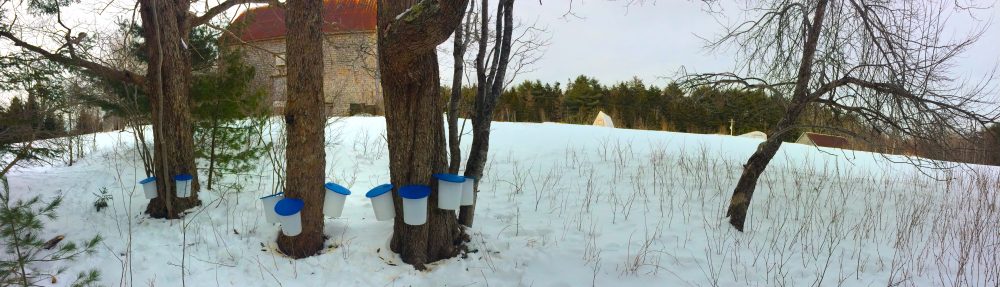
The holes that we drill in the maple trees need to be plugged at the end of the sap flowing. It was below freezing last night and 8 C today and the sap has stopped coming out of the spiles. The buds on the trees are looking full and ready to open. Hence the plugs.
You don’t want to leave a 1/2 inch hole in a maple tree because this could lead to an infection. You’ll need 1/2 inch plugs that are the depth of the drilled hole. The best plugs are from live maple trees, we have a few small re-grow clumps around the barn. Chamfering the end of the plug helps.
Once the plugs are hammered in the tree holes, it’s best to trim off any excess off flush with a small saw so the wound can heal properly. Sweet!
Maple Syncopation
We have a post about tapping our maple trees …. read more
YURN

It’s like rocket fuel for your plants … read more
Happy New Year … I can help
Many people make New Year’s resolutions totally meaning to keep the promises they make to themselves or others. Many people do not keep their resolutions and end up feeling worse about their predicament than before. I wanted to mention more about the skills and experience I have to offer just in case I may be able to help. The above 1 minute video is my solution to a song I couldn’t get out of my head.
If you are looking to lose weight or decrease/ quit a habit that you consider unhealthy, I have many ways to assist. I have been studying many aspects of psychology for years, am trained in counselling and am a great active listener. I have training in coaching to help people order their thoughts and be able to make effective decisions.
I studied Anti-aging medicine for several years and have a decent understanding of how the body and its systems change with age. I have a strong knowledge of nutritional supplements and nutraceuticals and often go over all of the remedies patients have at home to figure out if they are on what they need and using what they already have properly.
I have in depth knowledge for working with hormones, fertility management and have helped many women be able to achieve and keep a pregnancy.
Brian and I owned an organic spa for almost 8 years; I know a LOT about skin and helping it from the inside and the outside.
I have always felt very close to nature. Brian and I make most of the remedies we offer from the wild things, know how to identify a lot of medicinal and edible plants and eat wild food at almost every meal. I am happy to share this knowledge and help you find ways to bring more of nature into your life.
Most of the consults that I do are working with people who have had a chronic issue for years. But I also provide 20 minute consults for acute things like colds, an allergy flare up, bladder or yeast infections, and so on.
You don’t have to wait at the ER for hours to be heard and helped.
Ghost Pipe ( Monotropa uniflora )

These otherworldly plants revealed themselves to us last year. We knew they were important but not in what way. Thankfully the world is full of curious people who love to write about what they know. Sean Donahue is one of these people; he wrote an article concern monotropa that is so concise that all we can do is make it available here with much gratitude,
If you don’t want to support Central Bank Digital Currency ….
Image

Food Irradiation

We recently discovered that some of our foods are irradiated and have been for a long time. The Canadian Food Inspection Agency (CFIA) states, “Food irradiation is the treatment of food with a type of radiation energy known as ionizing radiation. Three different types of radiation are allowed: Gamma rays, X-rays and electron beam radiation. Ionizing radiation at the levels used for food irradiation contains enough energy to kill bacteria, molds, parasites and insects.”
They continue, “the following products have been approved by Health Canada for irradiation: potatoes, onions, wheat, flour, whole wheat flour, whole and ground spices, and dehydrated seasoning preparations.”
In addition, the sale of irradiated ground beef is also now approved. The irradiation of poultry is in its Submission Process.
The CFIA ensures that “pre-packaged foods that have been wholly irradiated must display the international radiation symbol ( the above symbol known as Radura ), along with a statement that the product has been irradiated. Food that is not pre-packaged must have a sign with this information displayed beside the food. Pre-packaged foods that contain an irradiated ingredient which is 10 per cent or more of the finished product must be identified in the list of ingredients as “irradiated”. If the ingredient makes up less than 10 per cent of the finished product, it is exempt from the labelling requirements.”
The Regulations Amending the Food and Drug Regulations (Food Irradiation) mandates that “when an irradiated food is not sold in prepackaged form, a sign displaying the radura symbol must be located immediately next to the food at the point of purchase.”
The amendment to the Foods and Drug Act further assures us that, “irradiated ground beef is required to be clearly labelled in accordance with the requirements set out in section B.01.035 of the FDR; consumers wishing to purchase irradiated ground beef will easily be able to identify it on store shelves.”
However, the amendment “under the current regulatory framework, no provision exists in the FDR to require the food service and restaurant industry to identify when irradiated foods have been used. Restaurants have the ability to advertise their use of non-irradiated ground beef as a voluntary consumer-value claim, as long as they are truthful and not misleading. If consumers have questions about how the food was produced, they should speak with the food service establishment directly.”
The Amendment addresses concerns raised by Stakeholders “that ground beef may pose a risk to the public due to the production of hydrogen peroxide and cyclobutanones, as well as with radioactive waste as a result of the irradiation process and transportation of such waste.”
Elaborating on the concerns, “When irradiated, the water found in meat can form hydrogen peroxide. However, hydrogen peroxide is relatively unstable (i.e. it decomposes easily) and any residues that may remain on the meat after irradiation are expected to readily break down to water and oxygen during post-irradiation storage. Alkylcyclobutanones are products referred to as “Unique Radiolytic Products” (URPs) that are derived from fat when irradiated and, therefore, their presence is directly related to the fat content of the food. These URPs are found in extremely small quantities in irradiated foods, in the order of parts per billion. The overall weight of evidence indicates that the very low levels of these compounds found in irradiated beef do not pose a risk to human health.”
A Citizens Group in the early 2000 published “Everything You Should Know About Food Irradiation in Canada”. Their research states;
1 ) Research dating to the 1950s has revealed dozens of health problems in animals that ate irradiated foods, including premature death, mutations and other genetic abnormalities, fetal death and other reproductive problems, fatal internal bleeding, immune system disorders, fatal internal bleeding, organ damage, tumors, stunted growth and nutritional deficiencies.
2 ) Irradiation disrupts the chemical composition of everything in its path not just harmful bacteria. Numerous chemicals known or suspected to cause cancer and birth defects can be formed in irradiated food, including benzene, ethanol, hexane and methyl ethyl ketone.
3 ) A class of chemicals formed in irradiated foods, called 2-ACBs which have never been found to occur naturally in any food were recently found to promote the development of cancer in rats, cause genetic damage in rats, and cause genetic and cellular damage in human and rat cells. Based largely on the toxic properties of 2-ACBs, the European Parliament has rejected a proposal to expand food irradiation.
4 ) Irradiation destroys or disrupts vitamins, protein, essential fatty acids and other nutrients in food sometimes significantly. The process, for instance, destroys 80 percent of vitamin A in eggs and 48 percent of beta-carotene in orange juice.
5 ) Irradiation can change flavor, odor and texture. Pork can turn red; beef can smell like a wet dog; fruit and vegetables can become mushy; and eggs can become runny and lose their color. (end of quote)
In Canada, the use of irradiation on these foods is not mandatory. Regulations allow the irradiation of these foods at the discretion of food producers.
However, the Canadian Broadcasting Corporation reports “over 50 countries with irradiation regulations permit the practice, including the United States, Australia and some European Union members. But it’s China that leads the world in the amount of food irradiated, according to the latest statistics from the Food Irradiation Update, which estimates that China irradiates a million tonnes of food, 40 per cent of it chicken feet. Pet food comes next, along with dehydrated vegetables, spices, herbs and seasonings, and seafood. Mexico, an important source of food for Canada, is steadily increasing the quantity of food it irradiates, although most of it goes to the U.S. Guavas top the list, which includes other produce. Food Irradiation Update says several large U.S. grocery chains carry irradiated Mexican produce.”
If you are going to eat Irradiated Foods .… we hope you feel it best to be informed.
GMO, Insects and Novel Foods
Recently, Brine and I noticed a news release that lesser meal worms had been approved as a food in the European Union ( read more ). House crickets had also been approved earlier in the same month. This information made me search to better understand how the commercial food supply is changing.
I checked into possible issues about eating insects. Here are some basic concerns some researchers came up with in 2015. In addition, it is not clear what they are feeding the edible insects? They have such a short life cycle whatever they eat really matters and will be part of our intake. So far most insect ingredients are being added for their protein content, which makes me think any vegetarian or vegan processed food will easily have insect ingredients in the near future as insects are not considered to be animals. Apparently none of the foods that contain insects will need to plainly state it contains insects. The labels will have the latin name for the insect ingredient which can easily be lost in the list of ingredients of any processed food, so if your preference is to not eat insects you might want to educate yourself on their scientific names.
Health Canada has been assessing the safety of GMO ( genetically modified organism ) foods ( and approving them for market ) since the early 2000’s. Health Canada has not had any mandatory regulations that a label must state that a food is or contains ingredients that are GM or Novel. Health Canada basically states that once their scientists feel confident that a food is safe and nutritious; they see it as equivalent to foods already on the market; it does not need special labeling ( read more ). My concern is that even if a new food has been shown to be safe in the short term, what is the long term or combined effect of eating more than one of these foods on health?
I found on the Health Canada website the “Completed safety assessments of novel foods including genetically modified (GM) foods” list. All of these foods are now on the market. You might want to take a few minutes to check out some of the patented foods and why they were created. One example is Event EF2-114 Pineapple, created by Del Monte, which is a pineapple with pink flesh instead of yellow. Another is the Arctic Fuji Apple Event NF872, created by Okanagan specialty fruits, which is an apple that won’t brown when cut. I personally find having the word Event being used as part of the name of a food, disturbing.
Brine and I endeavour to make careful and discerning food choices. For us, the above information has been making us look differently at the treat and convenience foods that we might consider as a reward … like sour cream and onion potato chips. This is a good reason to support your local farmer’s marketand to grow more of your own food. There are a few Nova Scotian seed saving providers such as Annapolis Seeds. This year, we purchased many new seeds varieties for grain growing from Salt Spring Seeds. You can buy more of your dry goods from Speerville Flour Mill, where 99% that they carry is organic and locally grown. We love that you can buy in bulk with friends or family to conserve more of your money.
If you are going to eat GMO, Insects, and Novel Foods .… we hope you feel it best to be informed.